When you buy through links on our articles, Future and its syndication partners may earn a commission.

HOUSTON — NASA's first astronaut close encounter with the moon in over 50 years will become a reality today (April 6), and you'll be able to follow it live online. But you will need to know when to tune in and for how long, and for that, we've got you covered.
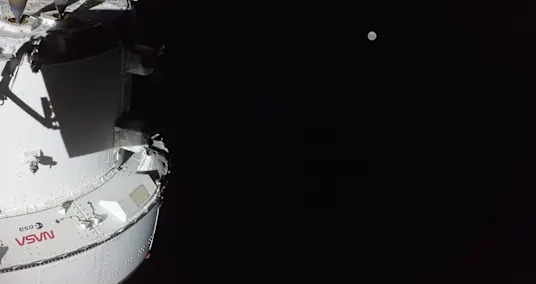
The four astronauts of NASA's Artemis 2 mission will fly around the moon today in a seven-hour flyby that will begin at 1:30 p.m. EDT (1730 GMT), but the crew has already captured stunning views of Earth's neighbor over the last few days. You'll be able to watch the moon flyby live on Space.com, courtesy of NASA, and follow the flyby as it happens on our Artemis 2 mission updates page.
"The four of us have looked at the moon our entire lives, and the way we are responding to what we're seeing out the window is just like we're a bunch of kids up here," Artemis 2 commander Reid Wiseman radioed to Mission Control late Sunday (April 5). "We cannot get enough of this. It's amazing."

Wiseman and his Artemis 2 crewmates — pilot Victor Glover and mission specialists Christina Koch and Jeremy Hansen — will be the first humans to see the moon up close since NASA's Apollo 17 mission in 1972.
They are the first astronauts to visit the moon in the 21st century, and they will see parts of the moon that NASA's Apollo astronauts were never able to, like the poles of the far side. They'll also see a rare solar eclipse from beyond the moon.
To help you know what to expect, here's a timeline of NASA's Artemis 2 moon flyby day, hour by hour.

Kelsey Young, Artemis 2 lunar science lead, said NASA has 10 science objectives and 35 different targets for the Artemis 2 crew to aim for during the flyby.
The astronauts will work in two-person shifts over five hours of the main flyby period. They'll use a tablet-based Lunar Targeting Plan app to record voice observations of their targets while also taking potentially thousands of photos of moon craters, plains and mountains.
"We've got a jam-packed plan for them tomorrow, and it ultimately all traces down to our objectives," Young said.
The astronauts have had several opportunities to observe the moon as they closed in on their lunar flyby. Based on their descriptions of the moon, NASA's lunar science team can't wait to hear the Artemis 2 crew's observations from today's flyby.
"They crushed it," said Jennifer Hellmann, an Artemis 2 science team lead from NASA's Ames Research Center in California. "We were excited for the flyby before, don't get me wrong. But we are, like, super, super excited now because they're so good! They're so well trained; they know what they're talking about."

The only Lego Technic NASA Artemis Space Launch System Rocket, once built it can 'launch' thanks to the clever Technic engineering mechanisms inside. It stands 27.5-inches (70 cm) tall but is made from only 632 pieces, making this suitable for ages 9+, compared with the adult-oriented (and $260) static Lego Icons NASA Artemis Space Launch System (10341) model.
LATEST POSTS
- 1
 Step by step instructions to Guarantee Your Internet Promoting Degree Supplements Your Profession Objectives
 - 2A coup too far: Why Benin's rebel soldiers failed where others in the region succeeded
- 3'Home Alone' actor Joe Pesci said 'no' to this stunt until he saw a 9-year-old girl do it, says director Chris Columbus
- 4Which Kind of Pet Makes the Incomparable Buddy?
- 5Building an Individual Brand: Illustrations from Forces to be reckoned with


- Former Peruvian President Pedro Castillo sentenced for conspiracy
- Early Thanksgiving week forecast: Where Americans can expect cold, rain and snow for the holiday
- Phenomenal Web-based MBA Stages for Proficient Headway
- How did I get my own unique set of fingerprints?
- How one man's concern saved his brothers from heart disease
- Ukrainian foreign minister appeals for funds for drones
- Investigating the Advantages of a Bank account: A Complete Aide
- Brazil expands pesticide packaging reverse logistics
- One spent $20 on candy. Another paid $700 for a custom costume. Here's how Halloween costs stacked up this year.