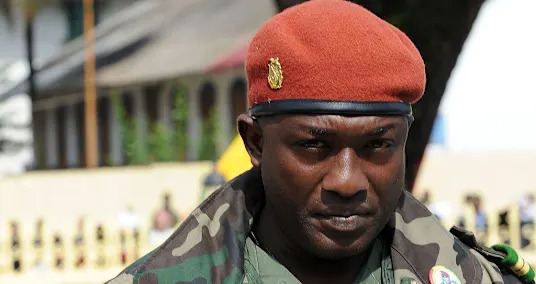
One of the key military figures convicted of crimes against humanity for his involvement in Guinea's 2009 stadium massacre has died in custody, authorities say.
Aboubacar Sidiki Diakité - also known as Toumba - died early on Wednesday in hospital following a medical emergency, the prison administration said.
He was serving a 10-year sentence for his role in one of the darkest episodes in Guinea's history in which more than 150 people were killed in the capital, Conakry, as they demanded an end to military rule. At least 109 women were also raped.
While in custody, Diakité remained a controversial figure, creating a political party and attempting to run for president.
Last year, he declared his intention to stand in the presidential elections, which was rejected by the Supreme Court after it ruled he was ineligible.
At the time of the massacre, Diakité was commander of the presidential guard and a close ally of Guinea's then military ruler, Moussa Dadis Camara.
According to the prison administration, Diakité was declared dead at the Samory Touré Military Hospital in Conakry, where he was taken late on Monday.
Citing his medical report, the administration said he presented symptoms characterised by gastric swelling, abdominal pain and constipation.
His death has prompted mixed reactions in Guinea where memories of the 2009 violence remain politically sensitive, with people still waiting for justice.
One political expert likened his death to "the end of an era", telling the BBC: "He died, but the full truth died with him."
Tens of thousands of people had gathered at a stadium on 28 September 2009 to protest against the possibility of Camara running for president.
On Camara's orders, security forces opened fire on the crowd. More than 150 people were killed and hundreds more injured.
According to judicial findings, at least 109 women and girls were also raped.

Camara survived a shot to the head shortly after the massacre, which was blamed on Diakité, according to the AFP news agency.
Diakité later fled the country and in December 2016, he was arrested in Senegal, where he was living under an assumed identity. A year later, he was extradited to Guinea.
After being shot, Camara spent 12 years in exile before returning to face justice. Following a 22-month trial, he and seven of his commanders were convicted in 2024.
Camara was sentenced to 20 years in prison for crimes against humanity, but pardoned in March last year by the current leader, Mamady Doumbouya - less than a year into his imprisonment - for health reasons.
His killing has underlined the unresolved tensions in Guinea's political landscape, where former military figures have continued to exert influence long after leaving power, and where the boundaries between justice, reconciliation and political ambition remain contested.
Guinea has experienced repeated periods of instability since independence, marked by military coups, contested elections and violent crackdowns on dissent.
Although the country has formally returned to civilian rule, efforts to address past abuses have been slow and, at times, deeply divisive.
In 2010 - shortly after the massacre - Alpha Condé won a presidential election. He was ousted in the country's most recent coup in 2021 by Doumbouya, who went on to win presidential elections last year.
Diakité's death raises fresh questions about the legacy of accountability and about the fate of those held responsible for one of the darkest episodes in Guinea's recent history.
More about Guinea from the BBC:

Go to BBCAfrica.com for more news from the African continent.
Follow us on Twitter @BBCAfrica, on Facebook at BBC Africa or on Instagram at bbcafrica
BBC Africa podcasts
LATEST POSTS
- 1
 Vote in favor of Your #1 4K television: Lucidity and Drenching Matter
 - 2Indian Health Service is digging out of decades-old construction backlog for medical buildings
- 3Pick Your Favored method of transportation
- 4Weather forecast, Turkana style: A goat's intestines tell it all
- 5Space debris: will it take a catastrophe for nations to take the issue seriously?




- 6 Famous Urban communities for Shopping on the planet
- Meet the rescue team behind the astronauts as Artemis II's launch approaches
- Freed whale gets stranded again off German coast
- Rediscovering Experience Through Excursions: Individual Travel Stories
- Astronauts head home early after medical issue
- UN rights chief says Israeli policy in West Bank 'resembles apartheid system'
- At least 55 injured in Russia after train crashes, overturns
- Real time features for Films and Programs
- 4 Dazzling And Well known Island Objections In US